
France Immigration Fee Revision: New Rates Announced

France has raised the taxes it charges foreign nationals for residence permits, long-stay visa validation and citizenship. The new rates apply from 1 May 2026. If you are planning a move, your total cost has gone up.
This guide explains what changed, what didn't, and how the revision affects Indian professionals.
What Changed and When
The increase comes from Article 128 of the 2026 Finance Act (Law No. 2026-103), promulgated on 19 February 2026. It amends the French code on entry and stay of foreigners and the general tax code. The new amounts took effect on 1 May 2026.
One detail matters for anyone with a pending file. The new rate depends on the date your permit is decided and issued, not the date you applied. A file submitted in April but decided in May falls under the new amounts. Naturalisation is the exception, as its fee is paid when you submit the application.
This is the biggest shift in France immigration costs for several years, so it is worth checking your budget again.
The New Rates at a Glance
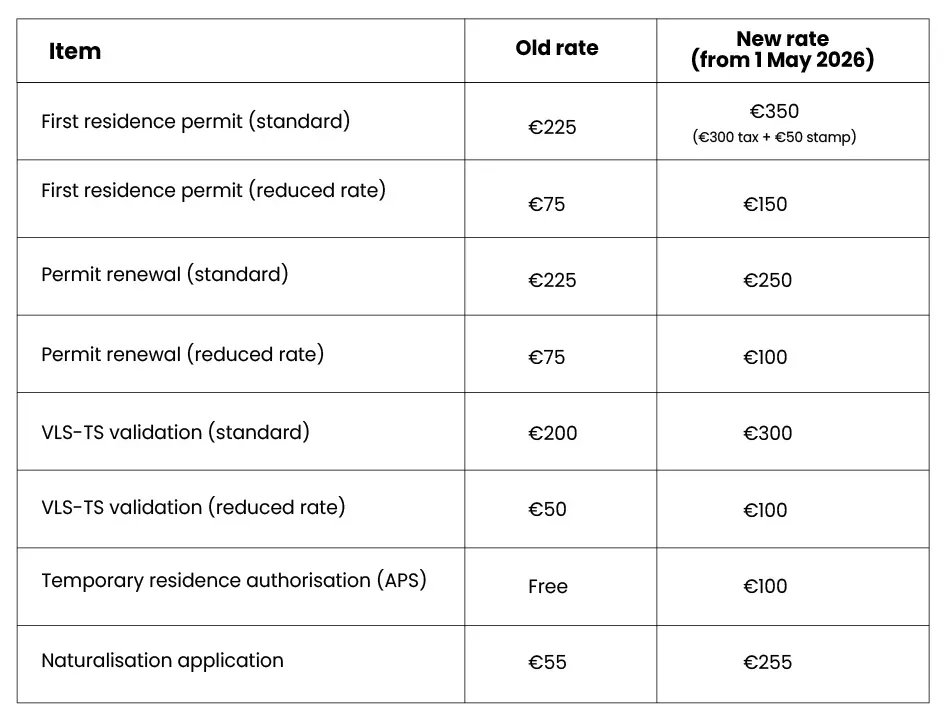
The reduced rate covers categories such as students, seasonal workers, au pairs, job seekers and family reunification applicants. Work routes generally pay the standard rate.
What Stays the Same
Not everything moved. The consular fees you pay abroad are unchanged:
- Long-stay visa fee: €99
- Short-stay Schengen visa fee: €90
The VFS Global service charge in India is also separate from these taxes. Its amount varies with exchange rates, so check the VFS France page before you book.
Exemptions for refugees, stateless persons and beneficiaries of subsidiary protection remain in place.
What It Means for Indian Professionals
Your costs come in two parts. You pay the visa fee in India. You pay the residence tax after you arrive in France.
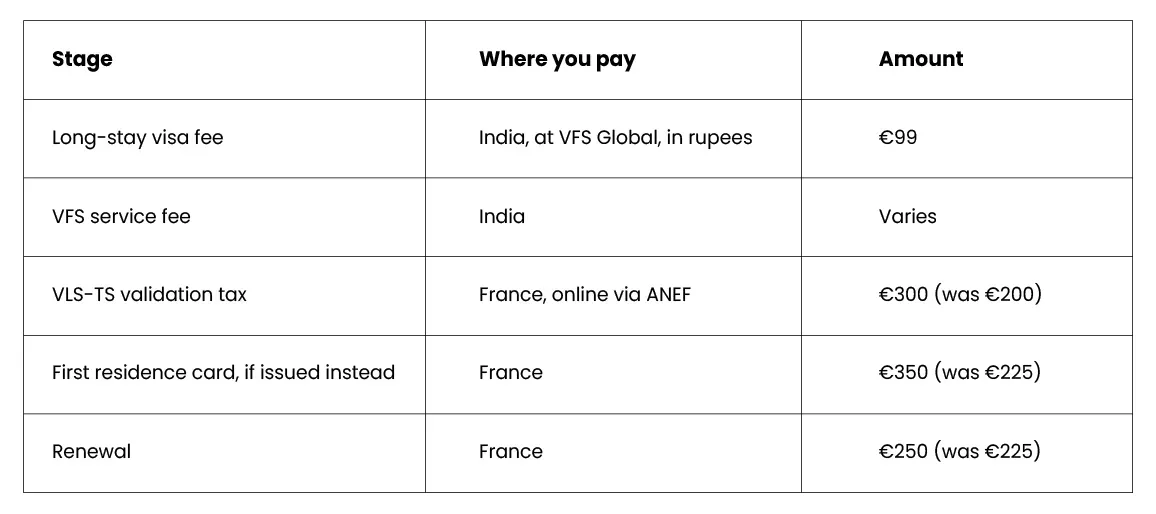
For a typical work route on a VLS-TS, the official government cost is now about €399 plus VFS charges, up from about €299. Some routes lead to a residence card at the first stage, and that is charged at €350. The exact figure depends on your visa type, so confirm it on ANEF or Service-Public.fr.
If you are applying for a France Work Visa with your spouse, each adult pays their own taxes. The increase therefore doubles across a couple. Rules for children differ, so check those separately.
The rest of the process is unchanged. The application steps, document lists and processing times are the same. Only the cost has moved.
Why the Fees Went Up
The change sits inside a budget law, which points to revenue as the main aim. It shifts more of the administrative cost onto applicants. France also updated other requirements during 2025 and 2026, including language standards for longer-term residence, so it is worth reading the current rules for your route.
How to Pay
Payment is by electronic tax stamp. You buy it on the official stamp platform (timbres.impots.gouv.fr) or through your ANEF account, using a payment card that works internationally. Pay only through official channels. No official process asks you to pay cash or send money to a third party.
What to Do Now
- Update your budget: Add the new post-arrival tax to your relocation costs.
- Check your route: Confirm whether you will receive a VLS-TS or a residence card.
- Use official sources: Check France-Visas, Service-Public.fr, ANEF and VFS Global for the latest amounts.
- Plan for renewal: Renewals now cost more, so budget for them from the start.
Conclusion
The 2026 revision to France immigration fees raised residence taxes, VLS-TS validation and naturalisation charges, while the €99 consular visa fee stayed the same. For most work applicants, the extra cost falls after arrival in France.
The increase is manageable if you plan for it. Confirm your visa type, check the figures on official portals, and budget for your renewal. Rules and amounts can change, so verify current details before you pay.
If you are planning a move and want to understand your total cost and next steps, speak with our experts or book a consultation. You can also explore our France services. For a full picture, read our France VS Ireland Article.