France vs Ireland Work Visa: Which Should You Choose?
If you're weighing a France vs Ireland work visa, you're really asking a bigger question. Which country gets you settled faster? With less friction for your family? And at a salary level you can actually meet?
Both countries offer strong, well-established routes for skilled professionals. But they're built on different philosophies entirely. Ireland is designed for speed. France is designed for scale and long-term European mobility. Neither is "better" in the abstract. It comes down to your profession, your salary band, and where you eventually want to put down roots.
This guide breaks down the france work visa requirements and ireland work visa requirements side by side. So you can see exactly where each system asks more of you, and where it gives more back.
Understanding France Work Visa Requirements
France manages skilled migration mainly through the Passport Talent framework. It was built specifically so employers could hire international talent without going through standard labour market checks. That alone makes it considerably faster than older, general work permit systems.
The EU Blue Card Route
The Talent Passport – EU Blue Card is the primary france work permit for high-skilled hires. To qualify, you'll generally need:
- A higher education diploma covering at least three years of post-secondary study, or five years of equivalent high-level professional experience
- A signed employment contract with a France-based employer for a minimum of six months
- A gross annual salary meeting the statutory threshold
The salary bar gets calculated using a 1.5 multiplier against the national reference wage, which currently puts the standard minimum at roughly €59,373. Shortage occupations in STEM fields get a reduced 1.2 multiplier though, bringing the floor down to around €47,498.
The good news? Labour market testing is waived entirely across all Talent Passport categories. Your employer doesn't need to prove no French or EU candidate was available.
The Qualified Employee Track
If your salary doesn't clear the Blue Card threshold, the Talent – Salarié Qualifié route offers a lower entry point. It calls for a master's-level degree (or five years of equivalent experience), a contract of more than three months, and a salary at or above the reference wage of roughly €39,582.
France also runs dedicated tracks for business creators and investors, with entry points built around business investment rather than salary alone.
Processing and fees: Standard applications take 30 to 90 days. Though fast-track processing of 20 days is available for shortage roles in AI, green engineering, and cybersecurity. Combined visa and residence permit fees run to roughly €449.
Understanding Ireland Work Visa Requirements
Ireland's system runs through the Department of Enterprise, Trade and Employment (DETE), and centres on two main permits. The Critical Skills Employment Permit (CSEP) and the General Employment Permit (GEP).
Critical Skills Employment Permit (CSEP)
The CSEP is the flagship ireland employment permit for roles on the official Critical Skills Occupation List. It's heavily weighted toward IT, engineering, life sciences, and healthcare. Key requirements include:
- A minimum gross annual salary of €40,904 (a reduced €36,848 applies to recent Level 8+ graduates)
- A minimum contract duration of two years
- No Labour Market Needs Test required
For roles outside the Critical Skills list, there's a high-earner CSEP route too, at a €68,911 salary threshold. As long as the role isn't on the Ineligible Occupations List.
General Employment Permit (GEP)
The GEP serves as the broader ireland work visa category, for roles that don't qualify under CSEP. It carries a lower salary floor, €36,605, but comes with a real trade-off. Employers must run a Labour Market Needs Test, advertising the role through EURES for 28 days plus one additional job site, to confirm no Irish or EEA candidate is suitable.
Processing and fees: CSEP applications typically take 2 to 8 weeks. GEP applications run 6 to 12 weeks. Permit fees stand at €1,000, with 90% refunded if the application's refused. Visa-required applicants also pay for a Long-Stay D Visa and Irish Residence Permit registration on arrival.
France vs Ireland Work Visa: Salary Thresholds
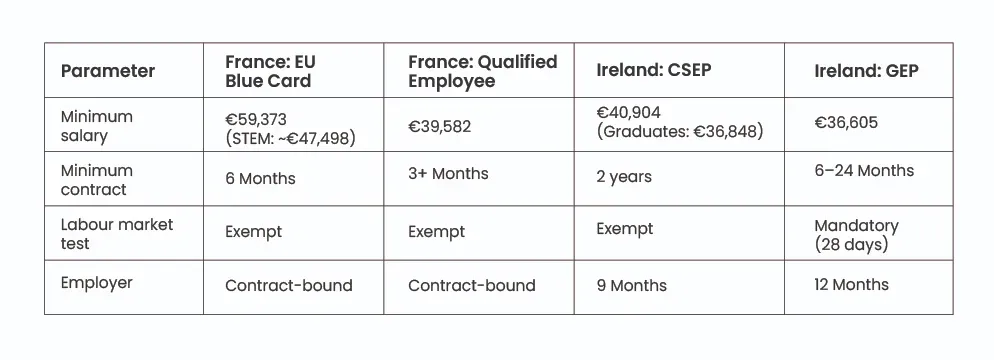
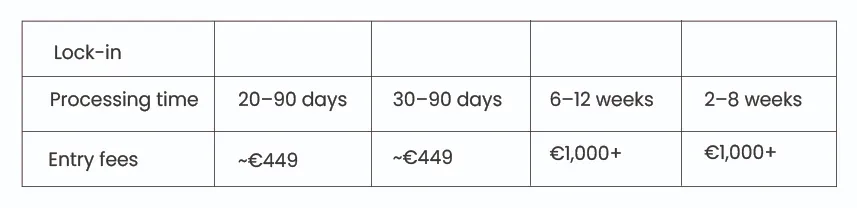
Salary thresholds and processing times get revised periodically by both governments. Always confirm current figures before applying — speak with our experts for the latest verified numbers.
Family and Spousal Work Rights
This is one area where the two systems diverge sharply. And it matters more than most applicants expect.
France applies one unified policy across all Talent Passport categories. Spouses and children under 18 can apply for family reunification alongside the primary applicant. And spouses get full, unrestricted access to the French labour market from day one. No separate work permit needed.
Ireland splits this by permit type. CSEP holders get immediate family reunification, and spouses receive a Stamp 1G permission with open work rights. GEP holders face a different reality, though. Family reunification can't be applied for until 12 months of employment have passed. And spouses arrive on a Stamp 3, which doesn't allow employment unless they secure their own work permit independently.
If you're relocating with a partner who plans to work, this distinction alone can shape which route actually makes sense.
Path to Permanent Residency
For a lot of professionals, this is the deciding factor
- Ireland (CSEP): After 21 to 24 months of continuous employment, CSEP holders can apply for Stamp 4 — long-term residency with no ties to a specific employer or permit. This is widely regarded as one of the fastest routes to unrestricted labour market access in the EU.
Ireland (GEP): GEP holders face a longer runway — five years of continuous employment before reaching Stamp 4 eligibility. - France: Both Blue Card and Qualified Employee holders need five years of continuous legal residence to qualify for the 10-year Resident Card or EU long-term residency status. Blue Card holders do gain the ability to move and work across other EU member states after just 12 months, something Ireland's system does not offer, since Ireland sits outside the Schengen Area.
Citizenship timelines follow a similar pattern. Ireland requires five years of reckonable residence within a nine-year window, and there's no language test. France also requires five years, but adds a mandatory B2-level French language requirement and a civic knowledge exam. Though international students who complete a master's degree in France can cut that residency requirement down to just two years.
Which Work Visa Is Right for You?
- Senior tech or STEM professional wanting fast, independent settlement: Ireland's CSEP is generally the stronger fit, with Stamp 4 reachable in under two years and no language testing requirement.
- High-earning executive prioritising mobility across the EU: France's EU Blue Card makes more sense, particularly if career growth may involve moving between EU markets.
- Recent graduate or student in Western Europe: A French master's degree followed by a Talent Passport can shorten the path to citizenship considerably.
- Professional relocating with a spouse in a non-critical role: Either the French Qualified Employee route or Ireland's CSEP works well. The Irish GEP is worth approaching carefully given its family reunification delay.
Every case is different. Salary thresholds shift as governments update their occupation lists and reference wages. So rather than relying on general comparisons alone, get your specific profile assessed against current requirements.
Conclusion
There's no single right answer to the France vs Ireland work visa question. Only the right answer for your profession, salary level, and long-term plans. Ireland rewards speed and independence, with one of the fastest permanent residency timelines in Europe. France rewards patience with broader continental mobility, and a wider set of entry categories for entrepreneurs and investors, not just employees.
The details that matter most — salary thresholds, occupation lists, and processing times — change periodically in both countries. Before you commit to a pathway, get your situation reviewed against the current rules.
Book a consultation with our team to figure out which route fits your background, or explore our full range of Ireland and France relocation services to see how we support you at every stage of the process.