
Ireland Employment Permit vs Work Visa: Key Differences
An employment permit and a work visa are not the same thing. The employment permit permits you to work in a particular job in Ireland. The visa permits you to enter the country. Indian citizens need both, and they come from different authorities at different stages.
Many applicants mix the two up. That usually leads to wrong assumptions about timelines, costs, and who is responsible for what.
What is the difference between an employment permit and a work visa?
The employment permit is about the job. The visa is about entry. You need a permit first, then you apply for the visa.
| Employment Permit | Entry Visa | |
|---|---|---|
| What it allows | Work in a specific role in Ireland | Travel to Ireland |
| Issued by | Department of Enterprise, Tourism, and Employment (DETE) | Irish immigration authorities |
| Based on | A job offer and the permit’s conditions | The permit and your travel documents |
| When you apply | After you have a job offer | After the permit is granted |
Once you arrive, you register with Irish immigration authorities and receive your residence permission. The permit and the visa don’t replace this step.
What are the types of Ireland Employment Permits?
There are several permits, each built for a different situation. The two most common for professionals are the General Employment Permit and the Critical Skills Employment Permit.
- General Employment Permit (GEP): Covers a wide range of roles. The job must not be on the Ineligible Occupations List, and a labor market needs test usually applies.
- Critical Skills Employment Permit (CSEP): For roles on the Critical Skills Occupations List, and for some other highly paid roles. It is generally the faster route to long-term residence.
- Intra-Company Transfer Permit: For employees moved to an Irish branch by the same group of companies.
- Contract for Services Permit: For employees of a foreign company working on a service contract in Ireland.
- Reactivation Permit: For people who lost their status in the system through no fault of their own.
- Dependant/Partner/Spouse Permit: For eligible family members of some permit holders.
Which one applies depends on your role, your qualifications, your salary, and your employer. It is not something you pick.
What are the Ireland Employment Permit requirements?
Requirements differ by permit, but most cases come down to four things: a job offer, a minimum salary, an eligible occupation, and the right qualifications.
Salary thresholds went up on 1 March 2026. The main figures are:
- General Employment Permit: €36,605 a year
- Critical Skills Employment Permit (with a relevant degree): €40,904
- Critical Skills Employment Permit (without a relevant degree): €68,911
- Intra-Company Transfer and Contract for Services: €49,523
Lower thresholds apply to recent Irish graduates. Government roadmaps also point to further changes in coming years, so check the current figure before you apply.
A few other points to keep in mind:
- The Labour Market Needs Test is not required for Critical Skills permits.
- A permit is tied to a specific job. A new employer usually means a new application.
- Meeting a salary threshold doesn’t mean a permit will be granted. The decision rests with DETE.
Ireland Work Visa eligibility for Indians: what applies to you?
India is a visa-required country, so you cannot travel to Ireland for work on a permit alone. Your Ireland work visa eligibility for Indians starts with the employment permit. Without a granted permit, there is nothing to base the visa application on.
After that, the visa application looks at your travel and identity documents, your permit, and the usual immigration checks. Requirements and supporting documents can change, so use the official Irish immigration pages as your reference.
One clarification. Many professionals applying from India hold a bachelor’s degree and several years of experience, but that is a general profile and not a legal rule. Each permit has its own education, occupation, and salary conditions.
How does the Ireland work permit application process work?
The Ireland work permit application process follows a fixed order. Skipping ahead causes delays.
- Get a job offer from an Irish employer for a role that qualifies.
- Check the permit category that fits the job, salary, and your qualifications.
- Submit the employment permit application online with the required documents.
- Wait for the DETE decision. Processing times vary, so don’t book travel yet.
- Apply for the entry visa once the permit is granted.
- Travel and register with Irish immigration authorities after arrival.
Fees and processing times change. Confirm both on the official sites at the time you apply.
What mistakes should you avoid?
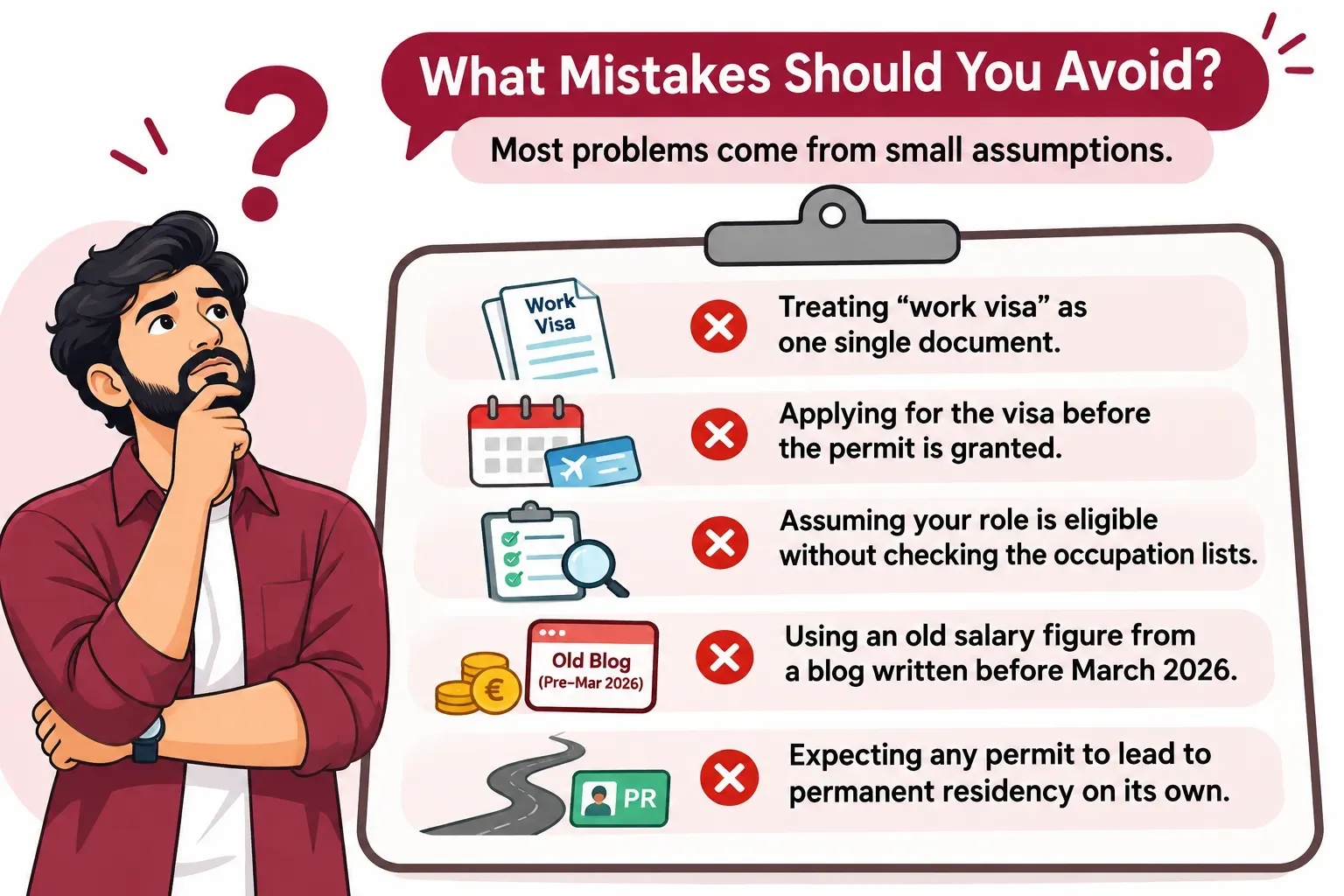
Most problems come from small assumptions.
- Treating “work visa” as one single document.
- Applying for the visa before the permit is granted.
- Assuming your role is eligible without checking the occupation lists.
- Using an old salary figure from a blog written before March 2026.
- Expecting any permit to lead to permanent residency on its own.
Does an employment permit lead to long-term residence?
Not automatically. An employment permit is a temporary permission tied to your job. Long-term residence, Stamp 4, and citizenship each have their own conditions, and they are separate steps. A critical skills permit is often the quicker route to long-term residence, but qualifying periods and rules can change. Check the current position with the Irish Immigration Service.