
Austria Work Permit Visa 2026
Austria updated its salary thresholds for 2026. If you are planning an Austria work visa from India, the numbers you saw last year may no longer apply.
This circular covers what Indian professionals should check first: the permit types, the 2026 salary limits, the fees, the documents, and the steps.
How the Austria work permit works
Austria has no single “work visa.” The process has two parts.
First, you get a residence title, such as the Red-White-Red Card or the EU Blue Card. This is what allows you to live and work in Austria. Second, if you need a visa to enter Austria, you apply for a Category D visa to collect that title.
Indian citizens need a visa. The residence application goes to the Austrian embassy in your country of residence, or your employer can file it with the residence authority in Austria. The Public Employment Service (AMS) checks the points, the salary, and the job market.
Which permit fits your profile?
This is the most important decision in the whole process. Each route has different rules.
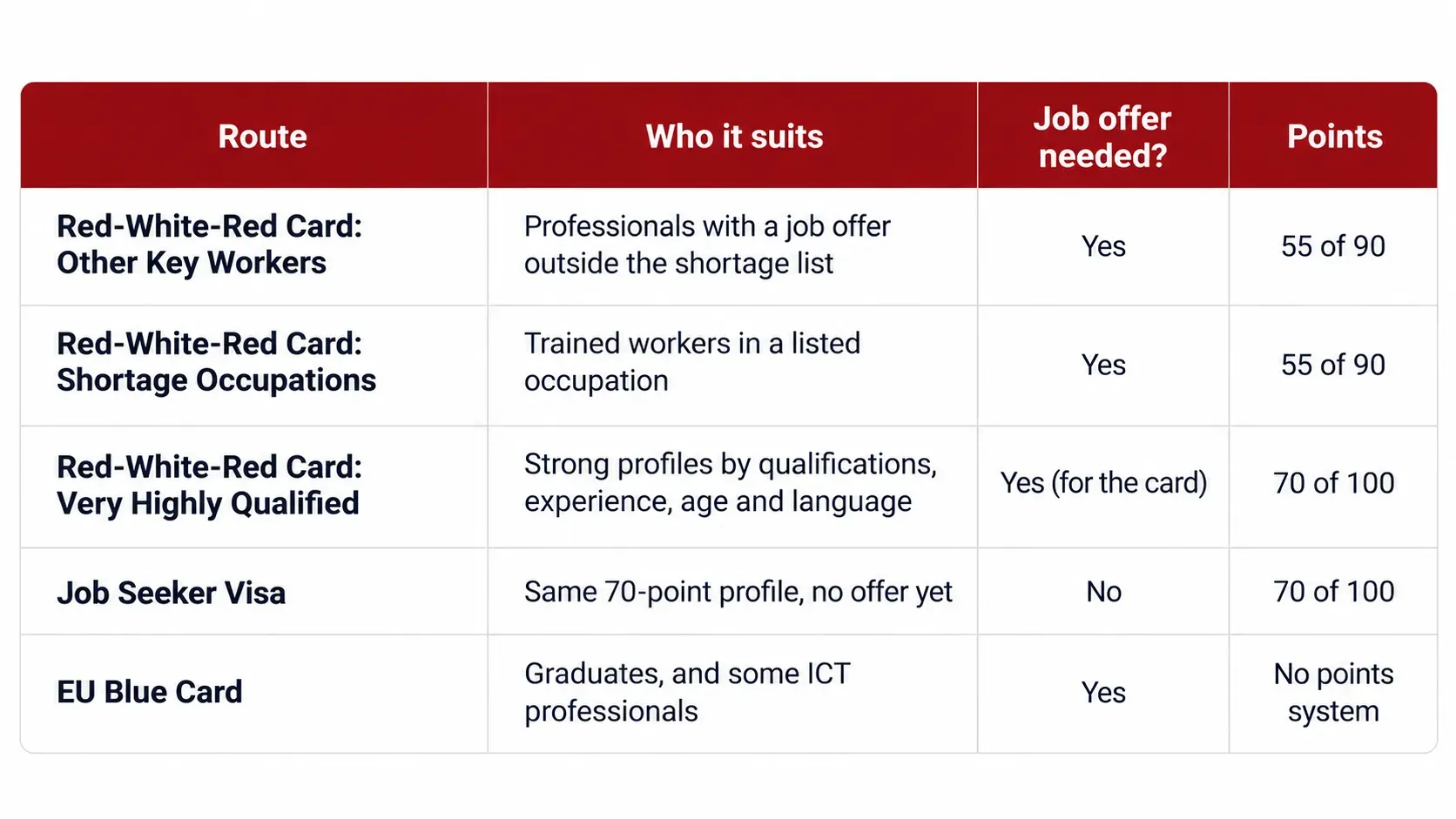
The Red-White-Red Card is valid for 24 months and tied to your employer. After 21 months of qualifying work within those 24, you can apply for the Red-White-Red Card plus. It gives you access to the whole labour market.
The jobseeker visa lasts six months. It lets you look for work in Austria, but you can only apply for the card once you find a matching job.
Austria work visa requirements and eligibility for Indians
Requirements depend on the route. These are the main ones for 2026.
Other Key Workers. Your employer must pay at least €3,465 gross per month. You need 55 points, and the AMS must find no equally qualified jobseeker already registered in Austria. Points come from qualification, work experience, language, and age.
EU Blue Card. You need a university degree of at least three years, or for ICT professionals, three years of relevant experience. You also need a binding job offer that matches your education and a gross annual salary of at least €55,678, including special payments. The labour market test applies here too.
Very Highly Qualified Workers. The scoring grid rewards things like a four-year degree (more for maths, IT, science and technology subjects), senior management pay, research work, awards, age and language.
Two points are worth knowing early. Austrian salaries are often paid in 14 instalments. A monthly figure can look fine and still miss the threshold once it is worked out the right way, so ask your employer how the offer is structured.
Also, formal recognition of your degree is needed only for regulated professions, such as health professions, teachers and lawyers. For most other jobs, your qualifications are assessed from your documents.
Documents you will need
- Authorities may ask for more, but most applications include:
- A valid passport
- A recent photo (45x35 mm, not older than six months)
- Proof of full health insurance
- The employer’s declaration (Arbeitgebererklärung)
- Certificates and proof of your qualifications
- Work certificates and testimonials
- Language certificates, if you claim points for them (not older than five years)
- A criminal record extract from your home country, often not older than three months
You will submit originals and copies. Anything not in German or English needs a translation, and some documents may need legalisation. Start this early. It takes longer than most people expect.
Austria work permit application process
- Secure a job offer, or check that you meet the points threshold.
- Confirm your permit category and the salary threshold before you sign anything.
- Gather and translate your documents.
- File the application. You can do this yourself at the Austrian embassy, or your employer can file it in Austria.
- The AMS checks points, salary and the labour market, then confirms to the residence authority.
- Once approved, apply for your Category D visa and travel to Austria to collect your residence title.
No official source we checked gives a fixed processing time. It depends on the permit, the authority and how complete your file is. Plan with a buffer.
Austria work visa fees for Indians
The official application fee for the Red-White-Red Card and the EU Blue Card is €218. The jobseeker visa costs €195.
Other costs sit outside the government fee. These include translations, legalisation, health insurance, and moving costs. If you work with a consultant, ask for a written, itemised list of what the fee covers.
Jobs in Austria for Indian professionals
Start with the official shortage occupation lists. They are published every year, with Austria-wide and regional versions, and the list changes. Check the current one before you rely on it.
An offer below the salary threshold may not support a valid application at all. Before you accept any offer:
- Confirm the employer is a registered Austrian company.
- Make sure the role matches your qualifications.
- Be careful with anyone who promises visa approval or asks for large payments before any paperwork.
Nobody can guarantee approval. The decision belongs to the Austrian authorities.
What to do next
Start with three checks: which permit fits you, whether the offer meets the 2026 threshold, and whether your documents are ready.
Our team can review your profile and walk you through the options. Speak with our experts for personalised guidance based on your qualifications and experience