Ireland CV Format: How to Write a Resume That Passes ATS Screening
You’ve found a great role in Dublin. Then you open your CV and It’s 4 pages long with a photo in the corner, and it ends with a declaration.
That’s a problem Irish employers expect something different. This guide shows you what to change and how to get past the software that reads your CV before Employer.
What an Irish CV Looks Like
Usally its just two pages in reverse-chronological order, so your latest job comes first. Most Irish employers prefer this layout and Skills-first formats are usually discouraged.
If you are a fresh graduate then you can use one page. 3 pages are mostly for experienced professionals
Recomnedations -
- Paper size: A4,
- Spelling: British or Irish English
- Dates: Day/Month/Year, or Month Year for job ranges
- Font: Arial, Calibri or Helvetica,
- Margins: 1.5 cm to 2.5 cm
Pick one spelling style and stick to it. Mixing US and UK spellings gives a negative impression.
How to Write a CV for Ireland, Section by Section
Follow this order.
1. Contact Header
Add your name, phone number, email and LinkedIn URL. Write about your city and country. Then add a line on your work permission status. You can skip the street address.
2. Personal Profile
2 or 3 sentences under your header. Say who you are, how long you’ve worked, what you’re good at and what you bring to the role.
Avoid objective statements because employers don’t have to know what you hope to gain.
3. Key Skills
Group all your skills in plain text. avoid putting designs like skill bars and ratings because Software can’t read them.
4. Professional Experience
List jobs from newest to oldest. Add title, company, location and dates. Then write your achievements in bullet points (more on those below).
5. Education and Certifications
Give the degree, university /college and year. Add the Irish qualification level too. We’ll cover that shortly.
6. References
Write “References available on request” or list two professional referees. Employers usually check references only after a conditional offer.
What to Leave Off Your CV
Data protection rules push employers to collect only what they need. So you can skip personal details while making your CV.
Avoid these:
- Photograph
- Date of birth, age or place of birth
- Marital status or family details
- Religion, caste or gender
- Nationality or passport number
- PPS number
- Full home address
Employers don’t expect any of it and it can your chances of getting the job too.
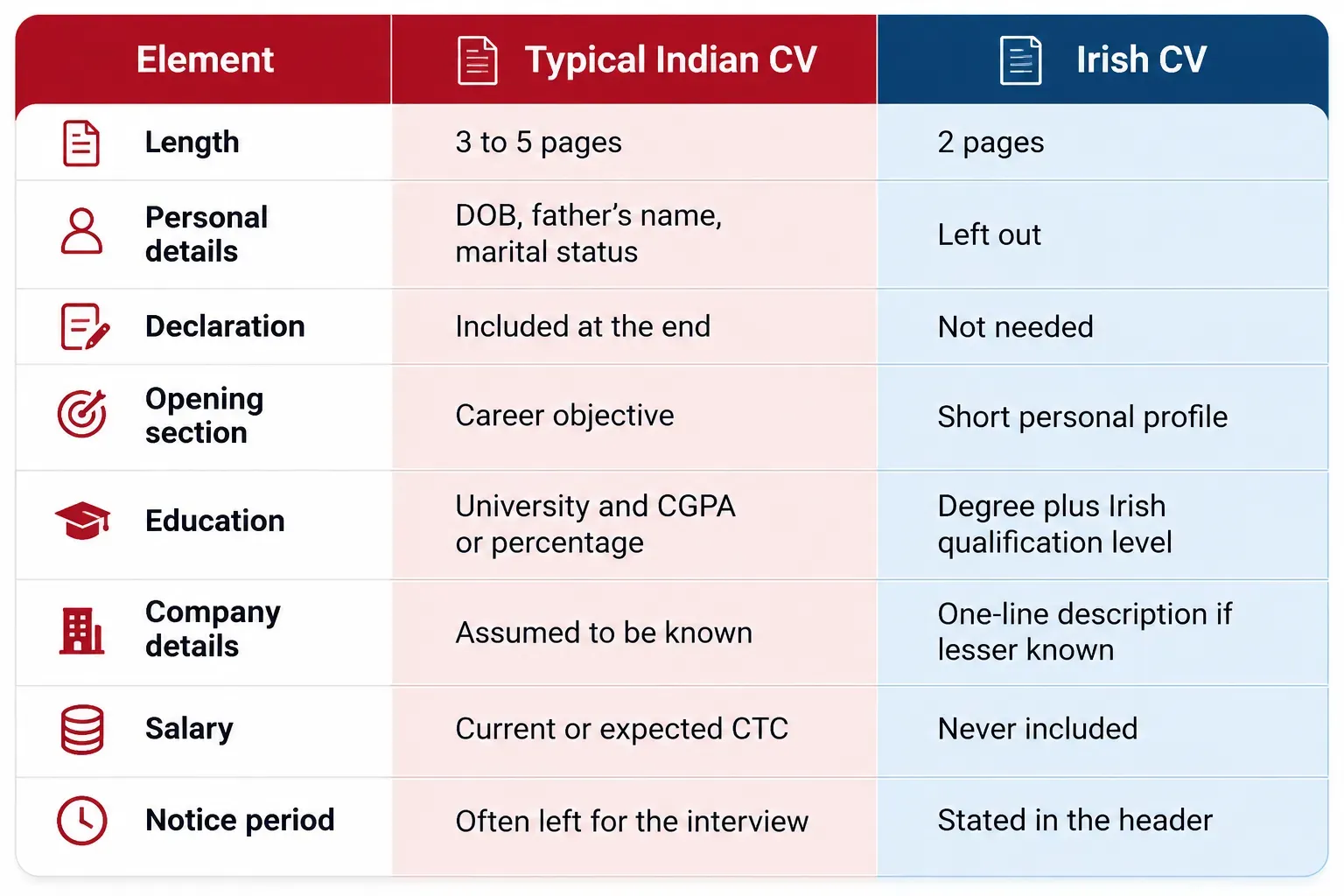
Indian CV vs Irish CV
Here’s what comparison between the Irish CV and Indian CV style.
Map Your Degree to the Irish Framework
Irish recruiters won't know about your education history. That’s where Quality and Qualifications Ireland (QQI) helps. Through NARIC Ireland, it compares foreign degrees to the Irish National Framework of Qualifications (NFQ).
A four-year B.E. or B.Tech generally maps to NFQ Level 8.
An M.Tech or M.Sc generally maps to Level 9.
You can check your own qualification on the QQI database.
For listing a CGPA or percentage, add the class equivalent, like “First Class Honours equivalent”.
Explain Lesser-Known Employers
Everyone knows Big MNCs but not mid-sized companies, so add one line under the company name. Industry, size, and what they do.
Cut the Length
Turn task lists into results. Roles older than ten years can be shrunk into one line with title, company, and dates.
Write Achievements, Not Duties
For writing achievements, use this pattern: action verb, context, measurable result.
Below are the examples -
Weak: “Responsible for managing the software team and writing Java code.”
Stronger: “Led a team of 8 engineers to deploy a microservices architecture on Java and AWS. Cut application latency by 35% and saved €45,000 a year in infrastructure costs.”
Good verbs to use: engineered, delivered, automated, streamlined, reduced, negotiated.
How ATS Screening Works
Most large employers in Ireland use an applicant tracking system, or ATS. Common ones include Workday, Taleo, Greenhouse, Lever, Smart Recruiters and SAP SuccessFactors.
The software strips out your design. It turns your CV into a database record and sorts the text into fields: name, contact details, work history, education, skills. If your layout confuses it, some parts of your CV can go missing.
Build an ATS-Friendly CV Ireland Recruiters Can Read
- Keep it simple. Use one column that runs top to bottom. Avoid:
- Tables and cells
- Text boxes
- Key details inside headers or footers
- Icons, logos, charts and skill bars
- Two-column layouts
Use standard headings as well. “Professional Experience”, “Education”, “Key Skills” and “Certifications” all work. Creative headings will confuse the software, e.g., "where I've been"
File Format
PDF is usually the best choice. Name it clearly, like Firstname-Lastname-CV.pdf. If the job post asks for Word (.docx), send Word.
Keywords
The ATS compares your CV with the job description. So use the employer’s own words. If the post says “Kubernetes” and “Project Management Professional (PMP)”, write exactly that. Don’t put in vague alternatives.
Place keywords inside achievement bullet points. A recruiter will read your CV after the software does, and they’ll spot a keyword dump right away.
One more thing. You’ll see claims online that 75% or more of CVs are rejected by ATS before a human sees them. No verified source backs that number up, so it's better not to build your strategy on it. A clean and readable file that matches the role will be much better.
Tailor Every Application
Don’t send one CV everywhere. Read the job description and note the main skills, tools, and duties, and make sure they show up in the top half of your first page.
You also might need a cover letter. Irish employers still expect one. Keep it to one page, 200 to 300 words. Address it to a named person if you can. Cover the role, two or three achievements that fit the job, your work authorisation, and your notice period.
CV for Critical Skills Employment Permit Candidates
Many Indian professionals apply for roles that qualify for a Critical Skills Employment Permit (CSEP). If that’s you, make your eligibility easy to see.
Match your job title to the occupation list: The role should appear on the Critical Skills Occupations List. It covers areas like ICT, engineering, science, and healthcare.
Show your qualification: A relevant degree at NFQ Level 8 or higher is the usual route.
State your permission status in the header: For example: “Location: Bangalore, India | Work Permission: Requires CSEP sponsorship.” Don’t make recruiters guess.
Salary Thresholds to Know
These figures apply from March 2026. They cover base salary only. Bonuses and allowances don’t count.
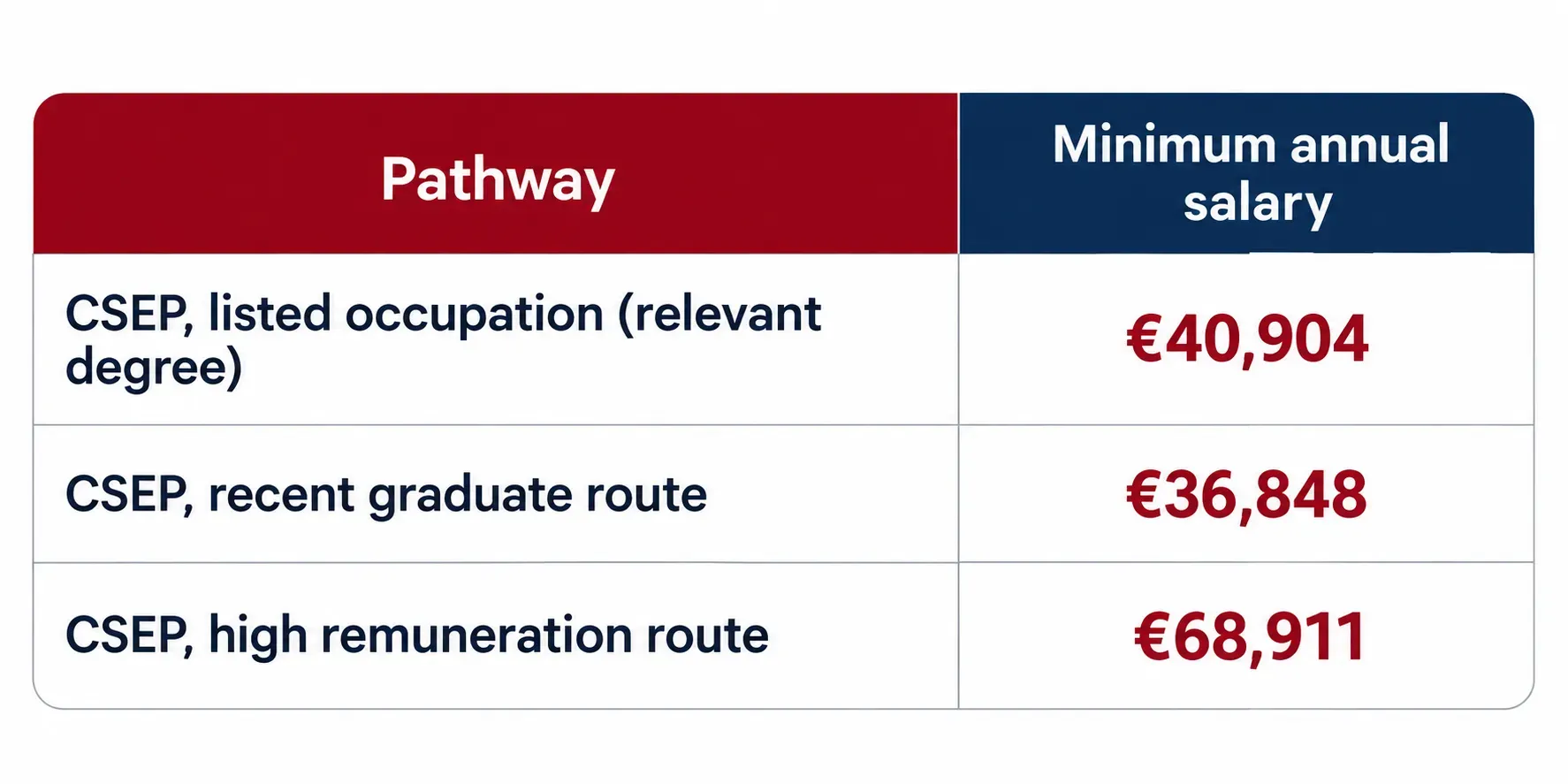
Don’t put these numbers on your CV. But they help you check whether a role can qualify.
A Few More Points
CSEP roles are exempt from the Labour Market Needs Test. Employers don’t have to advertise locally first. They also can’t recover permit fees from you. And under the Employment Permits Act 2024, you generally stay with your first employer for 9 months before moving to a new one in the same occupation category.
A Simple Irish CV Template
Need a starting point? Use this Irish CV template:
- Header: name, location, phone, email, LinkedIn, work permission line
- Personal Profile: 2 to 3 sentences
- Key Skills: grouped in plain text
- Professional Experience: newest first, achievement bullets with numbers
- Education: degree, university, year, NFQ level
- Certifications and Projects: relevant ones only
- References: “Available on request”
Build it in a word processor. Europass is known across Europe, but many Irish recruiters find it rigid. A custom two-page CV usually reads better. Check each job post too, because the Ireland resume format you send should still match what that employer asks for.
Mistakes That Get CVs Rejected
Most rejections come from a short list of errors:
- Adding a photo or personal details
- Using US Letter instead of A4
- Sending a long, duty-heavy Indian-style CV
- Leaving out work permission status
- Using columns, text boxes or graphics
- Skipping NFQ levels and company context
- Listing current or expected CTC
Run through this list before you hit send.
Conclusion
A strong CV for Ireland is short, clear and built on results. Cut the personal details. Stick to one column. Map your degree to the Irish framework. Show your work permission status. Match your wording to each job.
Get these right and both the software and the recruiter can see what you offer.
Not sure your CV is ready for Ireland? Speak with our experts and get personalised guidance. You can also look at our Ireland services or head back to the Irish Expert home page.
Also Read: How Smart resume marketing services in India opens doors to Ireland Jobs