
What Is the Critical Skills Employment Permit in Ireland?
The Critical Skills Employment Permit (CSEP) is one of the most important visas if you want to work or settle in Ireland. The permit is for professional individuals or families outside the European Economic Area (EEA) for occupations where Ireland has talent shortages. It also helps if you want to become a resident of Ireland
In this blog we are going to delve into understanding the CSEP, other work permits, salaries, processes, and job opportunities.
Because understanding the critical skills of the employment permit and other things will help you significantly if your plan is to shift to Ireland or work in it.
What Is the Critical Skills Employment Permit?
CSEP, or Critical Skills Employment Permit, is an Irish employment permit for professionals. One of its major advantages is that it does not require the Labour Market Needs Test. This means employers won't have to advertise the position locally before hiring you or any other individual.
If you want to proceed with CSEP, then you would need…
- A job offer from an Irish employer
- A contract of at least two years
- The required salary for the occupation
- Relevant qualifications or professional experience
- An eligible occupation
- An employer that meets the relevant requirements
If you are in a sector like ICT, engineering, healthcare, business, finance, and science then this permit is relevant to you.
What Are the Benefits of a Critical Skills Permit?
CSEP supports a faster transition to longer-term immigration status. CSEP holders can apply for Stamp 4 after 21 months of employment on the permit.
Getting Stamp 4 removes the requirement for an employment permit and can allow you to work for another employer or establish a business. With that, this permit also includes family reunification arrangements, just like a few other permits that we will discuss soon.
But stamp 4 and permanent residence are not the same. Getting STAMP 4 won't mean you will become the resident of Ireland.
Ireland's Different Work Permits and Salary Requirements
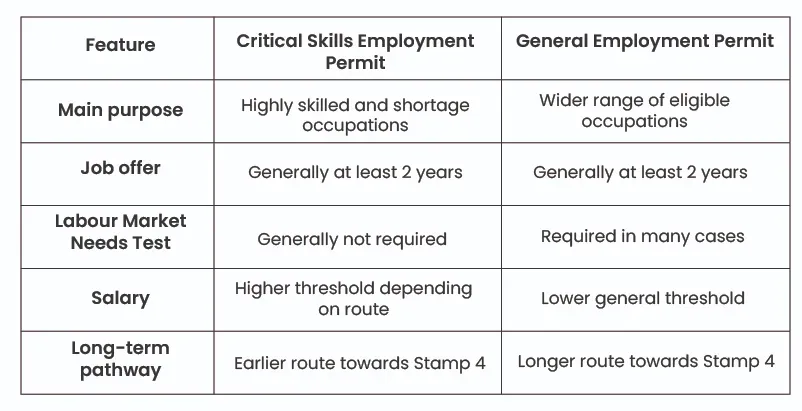
Below is the table showing the differences between General employment permit and Critical Skills Employment permit.
Salary Thresholds
Figures as of September 2026 include.
- €40,904 per year for occupations on the Critical Skills Occupations List
- €36,848 per year for recent graduates of Irish third-level institutions
- €68,911 per year for occupations not on the Critical Skills Occupations List, if the occupation is not on the Ineligible List
These figures can change, and it is mentioned as of September 2026; verify the current facts when proceeding.
General Employment Permit Salary
- €36,605 per year as the standard minimum
- €34,009 per year for recent graduates
- €32,691 per year for healthcare and agri-food occupations
Basic salary is only considered in the above figures. Incentives, bonuses, overtime, and other variables are not taken into account when mentioning the figure above.
How to Get an Ireland Work Visa from India
Step 1: Secure a Job Offer
First find an employer who is willing to hire you for a role.
If your role is on the CSEP list, then the job must meet the critical skills criteria, as we mentioned about it above.
If your role is related to a general employment permit.
Then your employer may need to participate in the Labour Market Needs Test if you are a non-EEA individual. For that, they need to advertise your job position for at least 28 days on public jobs in Ireland or EURES portal for a minimum of four weeks.
All of this process is overseen by DETE (Department of Enterprise, Trade, and Employment) and is a mandatory step.
Step 2: Apply for the Long-Stay D Visa
After the process above is done, you can apply for the D Employment Visa. Because you cannout simply apply for a visa without the authorization first.
Step 3: Travel to Ireland and IRP
Once the visa is approved, you can travel to Ireland. If you are non-EEA after arriving, you must register your permission and get an Irish Residence Permit (IRP).
Irish Residence Permit (IRP)
Irish Residence Permit (IRP) is a credit-card-sized registration certificate given to non-EU/EEA and non-Swiss nationals who have permission to stay in Ireland for more than 90 days
If you are on a "D" visa, border control will place a temporary landing stamp in your passport, which allows you to stay for up to 90 days, and you must register within this timeframe.
First-time registrations require an in-person appointment, and you must book this through the online portal on the Irish Immigration Customer Service Portal. If you live in Dublin, you can attend your appointment at the ISD Registration Office on Burgh Quay, but if you reside outside Dublin, your registration will be processed at your local Garda District Headquarters.
The standard fee for an IRP card registration is €300 (exemptions apply to minors under 16, certain family members, and specific visa types)
Your card is not handed to you during the appointment. It will be mailed via post to your long-term Irish address within 1 to 2 weeks.
Required Documents for an Ireland Work Permit
The exact document requirements depend on your permit category and your circumstances, but you should be prepared to provide the following.
Applicant Documents
- passport
- Recent passport photograph
- Updated CV
- Degree or qualification certificates
- Relevant professional certifications
- Employment or experience letters
- Professional registration or license, where applicable
For General Employment Permit applications, evidence relating to the Labour Market Needs Test may also be required.
Official Ireland Work Permit Fees
Employment permit fees depend on the permit type and duration.
The table below shows the government fees as of September 2026.
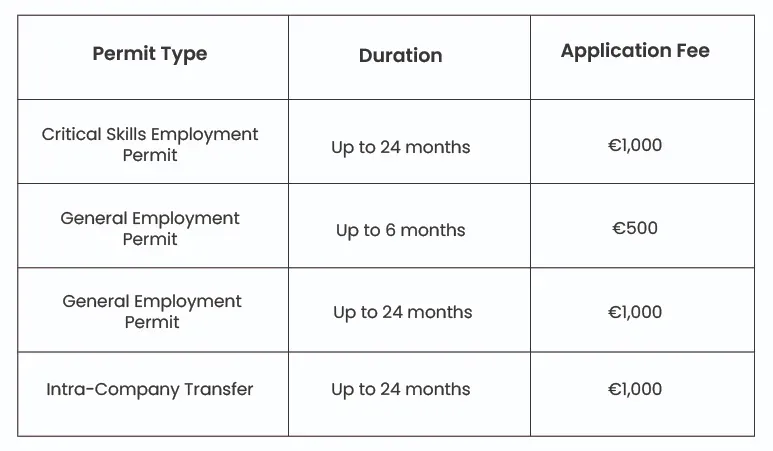
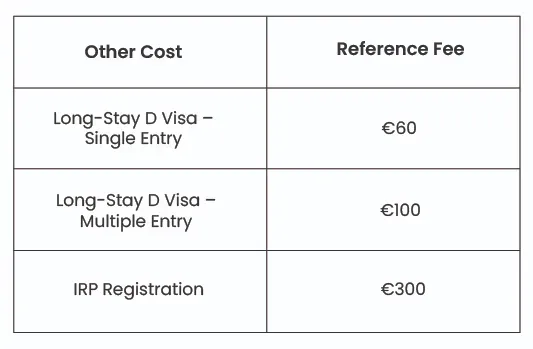
There can also be additional immigration costs; government fees are separate from costs such as document attestation, translations, medical examinations, travel and professional consultation.
Fees can change, so always confirm the current amount before submitting an application.
Jobs in Ireland: 2026–2035
Ireland's employment market is expected to continue changing as businesses invest in technology, healthcare, infrastructure and the green economy.
For experienced professionals, several sectors are worth watching.
Technology, AI and Data
Demand is increasingly focused on specialised technology skills.
Potential areas include:
- Artificial Intelligence
- Machine Learning
- Cybersecurity
- Cloud and DevOps
- Data Science
- Systems Architecture
Healthcare and Life Sciences
Ireland has a strong pharmaceutical, biotechnology and medical-device sector.
Potential roles include:
- Registered Nurses
- Medical Scientists
- Bioprocess Engineers
- Regulatory Affairs professionals
- Radiographers
- Physiotherapists
Engineering and Construction
Infrastructure and housing requirements are expected to support continued demand for professionals such as:
- Civil Engineers
- Structural Engineers
- Quantity Surveyors
- Site Managers
- BIM professionals
- Geospatial Surveyors
Renewable Energy
Ireland's transition towards a lower-carbon economy is creating opportunities in areas such as:
- Offshore wind
- Electrical engineering
- Grid infrastructure
- Sustainability
- Environmental services
Finance, Risk and Compliance
Dublin's position as a European financial services centre also creates opportunities for professionals in:
- Financial analysis
- Risk management
- Actuarial services
- Quantitative analysis
- Compliance
- Corporate taxation
Key insight: A high-demand occupation alone does not guarantee an employment permit. Your qualifications, experience, salary, employer and specific occupation must all meet the applicable requirements.
How Irish Expert Helps
Moving to Ireland for work involves more than securing a job offer.
You need to understand whether your profile matches the employment permit requirements, prepare the right documentation and follow the correct immigration process.
Irish Expert provides professional guidance to help applicants understand their options and plan their international career journey.
Our support can include:
- Profile assessment
- Work permit pathway guidance
- Eligibility assessment
- Documentation guidance
- Application process support
- Immigration guidance
- Career and relocation planning
The focus is on helping you make informed decisions based on your qualifications, experience and career goals.
Irish Expert does not guarantee employment or visa approval. Employment and immigration decisions are made by employers and the relevant Irish authorities.
Frequently Asked Questions
Can Indians apply for an Ireland Critical Skills Employment Permit?
Yes. Indian citizens can apply if they secure an job offer and meet the applicable CSEP requirements.
Do I need a job offer for a Critical Skills Employment Permit?
Yes. An job offer from an Irish employer is required.
How long should the CSEP job offer be?
A Critical Skills Employment Permit (CSEP) requires a job offer for at least two years.
Is the Labour Market Needs Test required for CSEP?
The CSEP is exempt from the Labour Market Needs Test.
Can my family join me in Ireland?
CSEP holders have more favorable family reunification options, but subject to the immigration rules as of september 2026
How much does an Ireland Critical Skills Employment Permit cost?
The reference government fee for a CSEP of up to 24 months is €1,000. Always confirm before applying because government charges can change.
Can I get permanent residence immediately after getting a CSEP?
No. The CSEP is an employment permit. It can provide a pathway towards longer-term residence, but permanent residence and citizenship are separate.
What jobs are in demand in Ireland?
Technology, healthcare, life sciences, engineering, construction, renewable energy and financial services are among the sectors with opportunities for skilled professionals.